

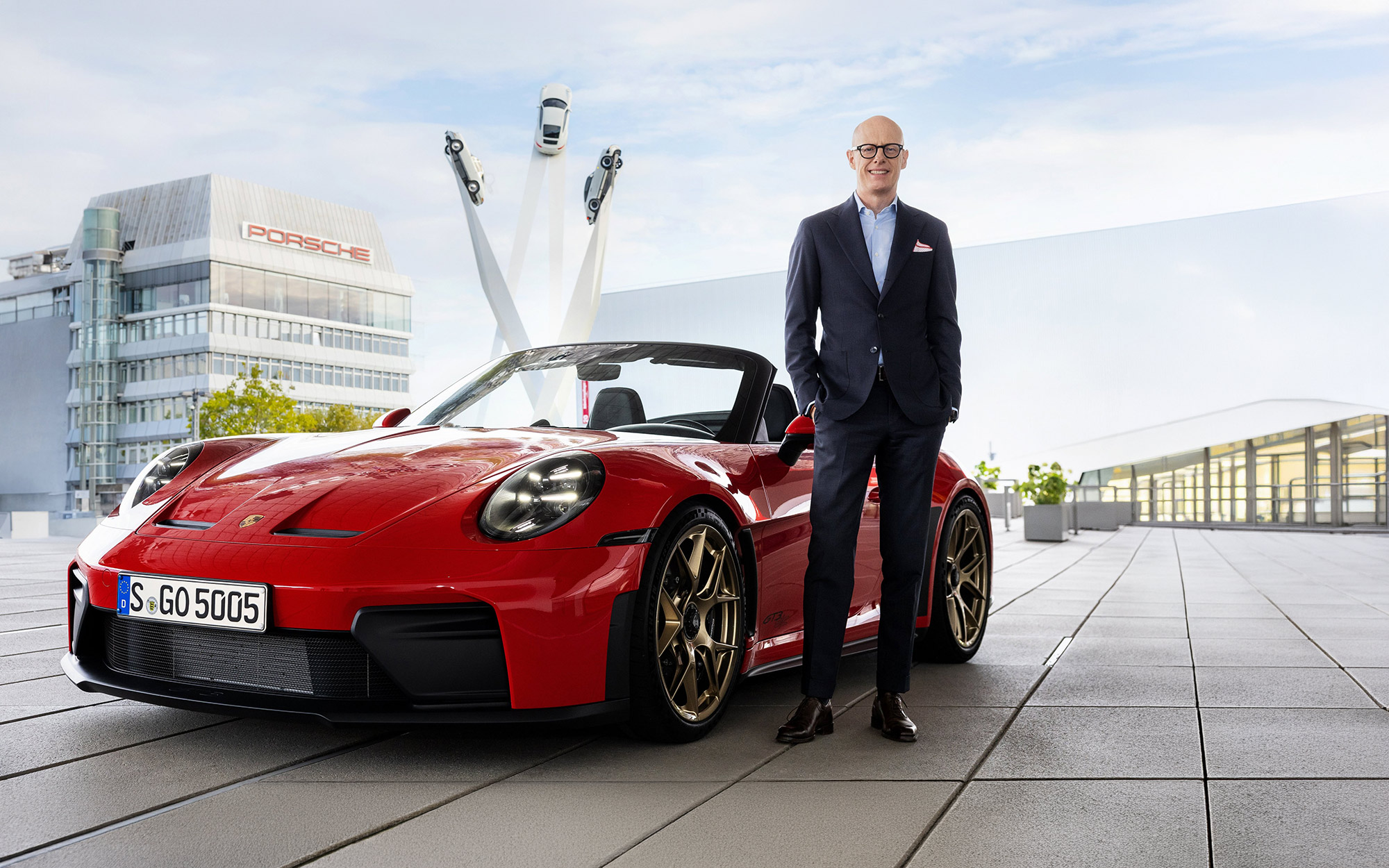

Porsche is making personalization, more exclusive vehicles and higher earnings per car central to a new strategy extending through 2035. Presented at its Capital Markets Day in Weissach, the plan combines an expanded Sonderwunsch offering with a proposed mid-engined sports car line above the 911, further performance projects with Manthey and a substantial reduction in operating costs. For buyers interested in individually specified Porsches, the clearest commitment is a plan to increase revenue from the Sonderwunsch business sixfold in the medium term.
Called Sportwagenschmiede ’35, the strategy sets out how Porsche intends to strengthen its sports car identity while becoming less dependent on sales volume. The company plans to offer fewer model variants, expand in more profitable market segments and generate more revenue from each vehicle. Personalization is a core part of that calculation, alongside new flagship products and a more efficient development and manufacturing operation.
SONDERWUNSCH MOVES TO THE CENTER OF THE BUSINESS
Porsche intends to expand its individualization offering systematically, increasing option revenue per vehicle and growing the business around highly personalized cars. Sonderwunsch sits at the forefront of that effort, with Exclusive Manufaktur also forming part of the broader strategy. The release does not specify additional facilities, staffing or production capacity for these programmes, but the sixfold revenue ambition signals a substantial expansion of their commercial role.
That target concerns revenue, rather than a stated sixfold increase in the number of Sonderwunsch vehicles. Porsche has not detailed how much growth it expects from additional commissions, more extensive projects or higher spending per customer. For Tailored Driver readers, the distinction matters: the company is committing to a much larger personalization business, while the precise mix of future services remains to be announced.
Porsche also wants to raise the average selling price of its top-of-the-range models by approximately 20 percent in the medium term. It says that increase will be supported by corresponding product substance, with expanded individualization and entry into higher-value segments among the means of achieving it. The strategy therefore links higher prices to changes in the cars and their specifications, although individual model pricing has not been disclosed.
PERFORMANCE, EXCLUSIVITY AND HERITAGE UNDER ONE UMBRELLA
Porsche plans to bring its Performance, Exclusiveness and Heritage activities together under the Home of Sports Cars umbrella. Performance includes Manthey, while Exclusiveness encompasses Sonderwunsch and Exclusive Manufaktur. Bringing these activities into a common framework gives Porsche a way to develop the relationship between factory personalization, performance upgrades and its history.
The Manthey component comes with a concrete ownership change: Porsche is increasing its stake in Manthey Racing GmbH to 67 percent. The expanded collaboration is expected to cover performance kits, exclusive track experiences and complete vehicle concepts produced in very small numbers. Those complete cars could become a particularly interesting part of the offering for collectors, though Porsche has not identified models, production quantities or launch dates.
Taken together, these plans suggest a broader range of ways to commission or develop a distinctive Porsche. Color, trim and craftsmanship remain part of the proposition, but the strategy also gives performance engineering and limited-production vehicle projects a larger role. How closely those services will be integrated for an individual customer is still to be defined.
A MID-ENGINED SPORTS CAR ABOVE THE 911
Porsche has announced development of a mid-engined super sports car platform intended to support a model line positioned above the 911. It is one of the most consequential product proposals in the strategy, opening space for a new flagship offering beyond the company’s established rear-engined sports car.
The announcement stops short of confirming a named production model. Porsche has not supplied a launch date, powertrain, price or production volume, and the release’s introductory summary describes the platform as a potential future project. The commitment is therefore best understood as a development direction, with the eventual vehicle programme still to be detailed.
The 911 will also receive additional flagship derivatives, while Porsche is exploring an SUV positioned above the Cayenne. Neither proposal comes with a full product brief. More broadly, Porsche plans to launch at least one brand-defining new product annually by 2030, alongside updates to existing model lines.
FEWER VARIANTS, MORE INDIVIDUALITY
An expanded personalization business will sit alongside a simpler core product range. Porsche aims to reduce the number of model variants by approximately 20 percent and increase sales per variant by around 30 percent in the medium term. It also plans to increase the share of its portfolio represented by the higher-margin D and E segments by approximately 45 percent.
These objectives illustrate how Porsche intends to reconcile manufacturing efficiency with exclusivity. Fewer underlying variants should reduce development and production complexity, while a wider individualization offering can give customers more choice in the finished car. That is the commercial logic of the plan; Porsche has not yet identified which derivatives will disappear or how ordering structures will change.
The company also says it will preserve an attractive entry point into the brand. Its strategy spans both sporty high-end premium and sporty luxury vehicles, allowing more accessible models to coexist with increasingly expensive flagship products.
ELECTRIC SPORTS CARS AND A NEW COMBUSTION SUV
The next product steps include the all-electric 718 Boxster and Cayman, which Porsche expects to support sales in their first full production year in 2028. A new SUV with combustion and plug-in hybrid powertrains is also scheduled to be presented in 2028, running alongside the electric Macan. Following its production ramp-up, Porsche expects that SUV to make a noticeable contribution to sales and profitability in 2029.
Porsche is retaining a three-pronged powertrain approach encompassing combustion engines, plug-in hybrids and electric vehicles. It plans further investment in combustion and hybrid technology as well as next-generation batteries, keeping multiple propulsion choices within its future portfolio.
Closer cooperation with Audi will support that work through the PPE and PPC platforms. Porsche says shared architectures will improve the use of development resources while brand-specific technology and features preserve each manufacturer’s character.
EXCLUSIVITY BACKED BY A SMALLER COST BASE
The product and personalization ambitions accompany an extensive restructuring programme. Porsche says an agreement with employee representatives includes a reduction of 9,000 jobs and protection for the core workforce through 2035. Separately, its medium-term objectives include reducing management positions by 40 percent and the workforce across direct and indirect functions by 25 percent, with a strategic workforce reduction target of 30 percent.
Porsche is also concentrating on its core automotive business. The release lists the sale of stakes in Rimac and Bugatti Rimac, an agreement to sell the MHP consulting subsidiary, and planned closures affecting Cellforce development and production activities, Porsche eBike Performance and Cetitec. Porsche Engineering and Porsche Digital are to be combined as Porsche Technologies.
Further targets include lower development, production personnel, distribution and material costs. A parallel quality initiative aims to improve the customer’s experience of products and service while reducing warranty costs by as much as 45 percent in the medium term.
WHAT THIS MEANS FOR BUYERS
Porsche’s financial objective is to become profitable at fewer than 200,000 annual vehicle sales, supported by higher value per car and a lower cost base. It is targeting a medium-term operating return on sales of 10 to 15 percent and an automotive net cash flow margin of 9 to 12 percent. These are ambitions rather than guaranteed outcomes, and Porsche acknowledges that reaching the upper end will require better external conditions or additional successful business initiatives.
For customers, the most relevant change is the planned expansion of what can distinguish one Porsche from another. Sonderwunsch, Exclusive Manufaktur and Manthey are being given a larger role at the same time that new flagship vehicles are being developed. The strategy offers a clear direction toward greater personalization and more exclusive products, with the details of future commissions, limited-production cars and the proposed supercar still to come.