

Albert Spiess and the Art of the Few-Off Lamborghini

Sant’Agata Bolognese’s few-off Lamborghinis represent the brand at its most experimental and expressive, but for more than a decade one private collector has become almost as synonymous with these machines as the factory that builds them. Swiss enthusiast Albert Spiess, long regarded as the pre-eminent guardian of rare Lamborghinis, is now speaking openly for the first time about how his passion for the marque took hold and why the few-off format became central to his vision of the ultimate collection.
Lamborghini’s modern few-off era began in 2007 with the Reventón, a stealth fighter–inspired V12 flagship that signaled a new willingness to push design, materials, and aerodynamics far beyond the limits of series production. Six limited-series models have followed, each offered in closed and often open variants: Sesto Elemento in 2010, Veneno in 2013, Centenario in 2017, Sián in 2019, and the Countach LPI 800-4 in 2021. They serve both as brand milestones and as rolling laboratories, previewing technical ideas and stylistic themes that eventually influence mainstream models.

Spiess has been there from the beginning. His path into Sant’Agata devotion started much earlier, however, with the purchase of a 1979 Countach LP400 S. That single decision, he says, altered his life: he shifted his priorities toward building an intentional, research-driven collection, adding a Miura SV and a Silhouette before turning his attention toward the rarest Lamborghinis of the modern era. Understanding provenance, celebrating unique specifications, and pursuing the pinnacle of engineering all became part of his self-imposed mandate. When Lamborghini formalized its few-off strategy, Spiess recognized immediately that the program aligned perfectly with his pursuit of absolute automotive individuality.
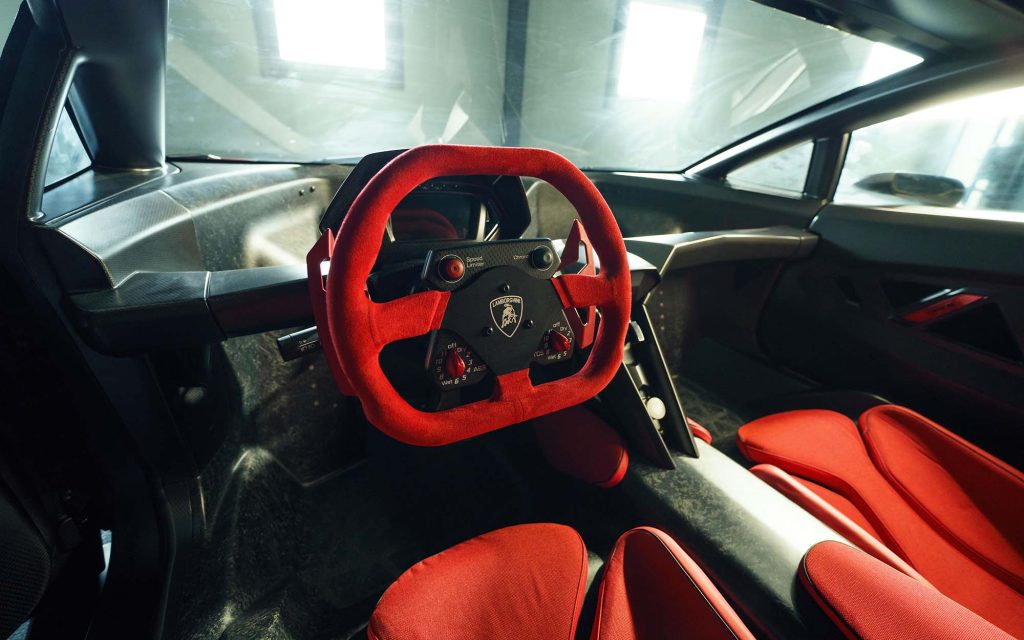
“Every one of them has arrived for a very specific reason,” Spiess explains. The Reventón Roadster came first for its angular form language, which would go on to define V12 production models through the Aventador. The Sesto Elemento followed, a car he calls his favorite for its radical lightweight ethos and structural carbon fiber. The Veneno Roadster joined the stable as a design statement bordering on science fiction. The Centenario appealed for its rarity and sense of occasion, while the Sián Roadster brought the brand’s first hybrid system into his collection. Most recently, Spiess added the Countach LPI 800-4, which he selected in part to honor the original 1971 prototype he helped reconstruct with Lamborghini Polo Storico.

What ultimately guides his decision to acquire each new few-off Lamborghini is not rarity alone but emotion. “Because every time I become as excited as I did the very first time, when I bought my first Countach,” he says. For Spiess, that feeling is the core of the collection — and the enduring allure of Lamborghini’s most exclusive creations.



























Responses